Neighborhoods


Strategic Neighborhood Transformation

Sidebar images:
Body:

The U.S. Senate early Saturday passed a $1.2 trillion bipartisan government funding package, which includes more than $2 million for Mahoning County. U.S. Sen. Sherrod Brown, D-Ohio, voted to approve the package that invests in Ohio, increases resources for border security, supports Ohio military installations and helps combat the addiction crisis. U.S. Sen. J.D. Vance, R-Cincinnati, was one of 24 senators who voted against the spending package in a session that ended around 2 a.m.

“This bipartisan package supports Ohio military installations, helps get border agents the support they need, and invests in communities across Ohio – from the Great Lakes to Piketon,” Brown said in a news release. “These critical investments will deliver on community projects proposed by Ohioans across the state, and help to do everything from cleaning up Lake Erie to making our communities safer.”

This is the second of two bipartisan funding packages needed to keep the government open. The first bipartisan bill to fund half the government was signed into law on March 9. This new package builds on that work and funds the remainder of the federal government through the rest of the fiscal year. Among the funds coming to Mahoning County is $1.45 million to the OH WOW! Center for Science and Technology in downtown Youngstown to provide advanced project-based learning for training and education in various STEM fields.

Also receiving a large financial boost is the COMPASS Family and Community Services COMPASS Campus of Care on the border of Austintown and Weathersfield townships. The money will be used for the renovation of a building to provide a behavioral health care / adult care / assisted living facilities for individuals living with severe and persistent mental illnesses.

The third recipient of funds from the government spending package is Direction Home of Eastern Ohio in Austintown, which received $239,000 for its Kinship Summer Camp in partnership with Easterseals. The camp’s intent is to provide respite for family members and caregivers, learning opportunities for the elderly and family stabilization.

PREVIOUS FUNDING

Earlier this month, it was announced that more than $22 million in federal funds will be coming to Mahoning and Trumbull counties — as part of another government spending agreement between the U.S. House and Senate — including $6.16 million to resurface the Youngstown-Warren Regional Airport’s primary runway and $4.2 million for a waterline in Lordstown. The package, which had more than 6,500 earmarks totaling $12.7 billion, includes several other big-ticket items for Mahoning and Trumbull counties. The Youngstown Air Reserve Station, adjacent to the airport, is receiving $2.5 million from this package for planning and design work for a new fire station. The station is estimated to cost $25 million. The village of Lordstown will get $4.2 million to make improvements to its water distribution system by replacing the Pritchard Ohltown Road water station and installing a redundant 24-inch waterline from Meander Reservoir. The projects at the airport, YARS and Lordstown were the three funded in Trumbull County at a total of $12.86 million. Eight projects in Mahoning County would receive a total of $9.80 million from Congress.

That includes $2.5 million each for Flying HIGH Inc., a Youngstown-based nonprofit, to help with infrastructure needed for housing development in the county, and for the Mahoning Valley Community School in Youngstown for a community learning center on the city’s South Side. The school purchased the former Job and Family Services building at 2026 South Ave. to turn it into a community learning center with plans to include a gymnasium, cafeteria, additional workforce development classrooms, a wellness center, a media center and a child-care facility. Youngstown received $1,284,652 for an interceptor sewer replacement and combined sewer overflow elimination project, $1.2 million to replace waterlines with lead in them and $400,000 for a transportation study for the East Side with a focus on looking at ways to connect it to an Interstate 80 interchange at state Route 304.

Also, the Youngstown Neighborhood Development Corp. would get $1.02 million for its ongoing effort to renovate the former Foster Theater on the city’s South Side into housing and businesses.

To read the full story from The Vindicator, click here

Sidebar images:
Body:

The U.S. Senate has narrowly avoided a government shut down with the approval of a $1.2 trillion spending package that would help fund key national concerns like border security and public school funding. President Biden has signed the bill, called the Further Consolidated Appropriations Act, 2024, which will provide funding through September 30 of this year. The six-bill funding package contains funding for 32 projects throughout the state, totaling to more than $28 million. More than $10 million that is slated to come to the Mahoning Valley. The lion's share of funding will go to Mahoning County, with Columbiana next and only one project being funded in Trumbull County from this money.

Below is the full list of all the dollars expected to come to the valley and where it will go:

Mahoning County:

COMPASS Campus of care: Renovating a building to provide a behavioral healthcare/adult care/assisted living facility for individuals living with severe and persistent mental illness, $750 thousand.

Direction Home of Eastern Ohio: To support the organization's Kinship Summer Camp Program, $239 thousand.

Youngstown Neighborhood Development Corporation: For the redevelopment of a vacant and blighted theatre in Youngstown into a multi-purpose building with living and commercial space.

To read the full story from WFMJ, click here

Sidebar images:
Body:

On March 21 at 5 p.m., a presentation was given to the Justice Roundtable of the Dorothy Day House summarizing the work in the past year of concerned citizen in Youngstown uniting as SOBE Concerned Citizens to prevent pyrolysis next to our revitalized downtown. About one year ago, March 30, Thomas Hetrick spoke at the Dorothy Day House about How Youngstown City Zoning Can Keep SOBE from Expanding from a Steam Heating and Cooling business to an industrial concern. He read the zoning opinion written by Jack Daugherty, a certified city planner employed by YNDC. SCC took this document and created a Zoning Petition.

They canvassed the city and on May 9, 2023 presented the over 550 signatures to Mayor Jamael Tito Brown urging him to inform SOBE they could not pyrolyze tires here. Ultimately, the petition was signed by approximately 700 citizens. The SCC conference May 18, 2023 across from SOBE site, the tabling at Earth Day, May Day, and Juneteenth to inform the public was discussed, as well as many more public education actions taken by the group. SCC thanked Buckeye Environmental Network whose director, Teresa Mills, (died Dec. 2, 2023) got a grant from the Ben and Jerry Foundation that helped them activate the community with a website, billboard, direct mailers, yard signs and posters and support materials for public meetings.

SCC had a massive postcard, calling and letter writing campaign to the OH EPA urging them to not issue an air pollution permit to SOBE, during the public comment period on the DRAFT permit Aug.10-Sept.10. SCC thanked their pro bono legal team: the Kramer Law Clinic of the Case Western Reserve Law School, who was responsible for writing: the Resolution passed by Youngstown City Council to reject SOBE Sept. 20, 2023, Legal Zoning Analysis for City’s Use, and One Year Moratorium Ordinance passed by City Council and signed into law by Mayor Brown on December 26, 2023 The presentation covered the February 7 & 8, 2024: SCC Testimony to US EPA and US State Dept. with Beyond Plastics Because of American Chemistry Council, the lobbyists for the Petrochemical Industry pushing “Advanced Recycling” to the U.N. Climate Council. SCC were invited by Jess Conard of our affiliate, Beyond Plastics as a “frontline community” to talk about fighting pyrolysis plant SOBE Thermal in Youngstown.

To read the full story from Mahoning Matters, click here

Sidebar images:
Body:

Thursday, March 28, 2024.

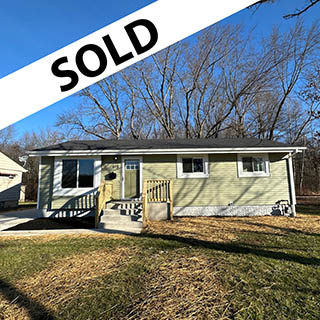
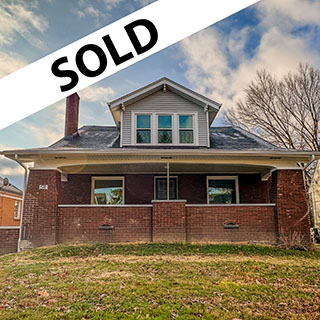
In March 2024, YNDC sold a fully revitalized home to a new homeowner. 615 Liberty Road sold for $85,000. Congratulations to the new homeowners and thank you for your investment in Youngstown’s neighborhoods.
 

Sidebar images:
Body:

A restaurant on Youngstown’s South Side is celebrating its first year of being open and the revitalization of businesses in the area. Savannah Joe’s is on Glenwood Avenue.

Owner Joseph Bowers opened the restaurant with family recipes inspired by his hometown of Savannah, Georgia. Bowers says he grew up visiting family in Youngstown and says it’s great to see the continued development along the Glenwood Avenue corridor. “It’s great to see the Youngstown area coming back. I live in this neighborhood, and it’s good to see the Youngstown area revitalized and coming back to its former glory,” he said.

Bowers adds he’s grateful for all his customers and the support that’s kept him in business over the last year.

To read the full story from WKBN, click here

Sidebar images:
Body:

Monday, April 1, 2024. 

On Friday, February 9, the Thomases Family Endowment of the Youngstown Area Jewish Federation awarded a $10,000 grant to the Glenwood Neighbors Community Safety Program.

The safety program will engage residents and business owners in the neighborhoods along Glenwood Avenue in Youngstown in a coordinated effort to prevent crime by using evidence-based practices for crime prevention through environmental design (CPTED), including installing lighting and doorbell security cameras on homes, businesses, and in public spaces that are in the vicinity of hotspots of violent crime. YNDC will work with resident leaders, business owners, and the Youngstown Police Department to implement the program.

Many thanks to the Thomases Family Endowment of the Youngstown Area Jewish Federation!

Sidebar images:
Body:

City council agreed to increase the amount of a remediation and partial demolition of 20 Federal Place by more than 22% to correct a mistake when the initial legislation was approved and to cover additional costs for the work. The initial ordinance, approved Nov. 15, 2022, had the project’s cost at up to $6.25 million. Charles Shasho, the city’s deputy director of public works, said he made an error in the initial proposal. Council agreed Tuesday to increase the project’s cost to up to $7.65 million.

The city received a $6.96 million Ohio Brownfield Remediation grant, announced in June 2022, for the project. So the $6.25 million in the November 2022 legislation already was too low by about $750,000. The city hired Daniel A. Terreri & Sons, a Youngstown company, in March 2023 for the work at a cost of $6.98 million. The price went up to $7.07 million in October because of the need to remove additional ceiling and floor tiles, Shasho said. While the administration is asking council to increase the price to $7.65 million, Shasho said he expects it to cost just under $7.5 million, but wants a little cushion in case of unforeseen issues. “Once they started the project there were things uncovered in the walls,” city Finance Director Kyle Miasek said. “There were unknown costs we learned about as they did the project.”

Councilman Mike Ray, D-4th Ward, said once the project is finished, the environmental concerns at the city-owned building will be resolved. That will make it easier to sell the building at 20 W. Federal St., he said. In addition to the $6.96 million state grant, the city provided $2.32 million of its own money for the work at 20 Federal Place. That includes paying a portion of the Terreri contract as well as about $500,000 in architectural designs and costs related to seeking additional grants for the building. The project, which started in April 2023, has been delayed repeatedly. It was supposed to be done in November, then February and just a month ago, Shasho said it would be finished April 1. Now, Shasho said the “substantial completion” date is April 15.

But demolition work to the rear of the building requires masonry work to close that space and that won’t be finished until May 31, he said. Deputy Law Director Adam Buente said Tuesday that Desmone Architects, the Pittsburgh firm that is involved in planning the redevelopment of the building, took a potential redeveloper on a tour of 20 Federal Place last week. The city is looking for a company to redevelop the building. A Desmone umbrella organization, 20 Federal Place LLC, has a 40-year lease on the building, Buente said. But there are benchmarks in the lease that Desmone must achieve at specific times, he said. If they’re not reached, the city can rescind the lease, he said. Without the city’s knowledge, Desmone reapplied and received a $10 million state historic preservation tax credit for 20 Federal Place, announced Dec. 21. That also comes with $14 million in federal historic preservation tax credits. Under historic tax credit rules, a government entity, like Youngstown, isn’t eligible for those dollars and the money must be awarded to a private group. Desmone’s application for the tax credits states an $82,137,690 project is planned at 20 Federal Place though no project has been finalized and the search for a redeveloper is ongoing. The city purchased the building in November 2004 after Phar-Mor, a national retail store company, went out of business. The property was the Phar-Mor Centre, the company’s corporate headquarters. Before that, it was the flagship location of Strouss’ department store for several decades. The city has unsuccessfully tried to sell the building in the past. There were 19 tenants, taking up about 20% of the 332,000-square-foot building before eviction notices were sent in July 2022.

CITY BUDGET

Council also voted 7-0 Tuesday to pass a $209.7 million budget for 2024. The city plans to hire 11 more police officers and three more firefighters this year and would seek to add more hires in both departments should current employees leave, Miasek said. The city also wants to add three employees this year to the community planning and economic development department including a chief planner, a position that has been vacant since March 2009. The city went through the process last year of testing for the job and four people met the requirements. But the administration decided not to hire any of the candidates. Among the larger purchases planned for this year are $600,000 for a new sanitation truck and $1.2 million for the street department, including two new snowplows for about $300,000 each as well as $600,000 for new police vehicles. The city ended 2023 with $52,481,100 from its 2.75% income tax and business profit tax. That’s an increase of 3.15% from the $50,879,800 the city collected in 2022. Miasek had predicted a 2.4% increase. It was a record high income tax collection amount for the city. Miasek expects an increase of about 1.5% to 1.7% in 2024 though that could change.

ARP SPENDING

Council voted 7-0 to spend $48,000 in American Rescue Plan funds to have MBH Construction upgrade the wooden walkway and steps to the deck at the Spring Commons Park to concrete.

It voted 5-2 to give $52,000 from Councilwoman Antia Davis’ 6th Ward ARP fund for the Youngstown Neighborhood Development Corp. to do renovations and improvements to Beyond Expectations Barber College on Glenwood Avenue.

To read the full story from The Vindicator, click here

Sidebar images:
Body:

With Youngstown Councilwoman Amber White again seeking Wednesday to repeal $1.3 million in American Rescue Plan spending her predecessor got approved in her last meeting for a park project, the board of control called a special meeting for earlier that day to vote on signing the contract. The request by White, I-7th Ward, for council Wednesday to repeal legislation it approved Dec. 20 at the request of Basia Adamczak during her final meeting on city council is almost certainly going to fail as it did during White’s first attempt Feb. 21.

White’s request to repeal the $1.3 million for the Youngstown Foundation to serve as fiscal agent to turn Ipe Park into the city’s first all-inclusive park was included in council’s legislative package, distributed last Wednesday, for its 5:30 p.m. meeting this upcoming Wednesday. The board of control on Monday afternoon called a special meeting for 9 a.m. Wednesday — eight and a half hours prior to council’s meeting — to enter into the fiscal agreement with the Youngstown Foundation for the $1.3 million park project.

Attempts on Monday by The Vindicator to reach White and Mayor Jamael Tito Brown were unsuccessful. But the move is an obvious attempt by the Brown administration to kill White’s second effort to repeal the ARP expenditure despite its near-certain rejection. White posted Thursday on Facebook that she “had to make a very tough decision” to again sponsor the repeal “due to the continued lack of information regarding” the Ipe project. She added, “We are now into the second quarter of the new year and even after the one year of previous work, I still have only vague details about the project to show the residents.”

White contends people were misled about a matching $1.3 million and recently a resident told her Ipe on East Midlothian Boulevard was never researched for how an all-inclusive park specializing in autism would fit at this location. White added “There was never any documentation of questions asked by the residents of what they would like to see done at the parks. We do not even know how much this park will cost. I have asked, residents have asked and still nothing.” She urged people to request to speak in front of council Wednesday in opposition to the park. “When all I hear continuously is upset residents about this chosen location and lack of information, I have to do what the majority wants,” White wrote in the Facebook post.

Councilman Julius Oliver, D-1st Ward, said, “I stand with the mayor and the citizens of the 7th Ward. What’s going on is ridiculous. Let it go.” White has also again requested that council repeal $52,000 for neighborhood block watches through the Youngstown Neighborhood Development Corp.

To read the full story from the Vindicator, click here

Sidebar images:
Body:

Green spaces not only provide recreation and natural beauty but stabilize property values of nearby neighborhoods. Green spaces like parks offer assets that attract people and development. Hunter Morrison is an urban planner who worked on the Youngstown 2010 plan 20 years ago and still works as a city consultant. As part of the development of the 2010 plan, community members were asked to list community assets. Mill Creek MetroParks topped the list. “It’s an asset from a variety of perspectives,” Morrison says. “It’s quality of life, but it’s also an asset in terms of holding real estate values.”

NEIGHBORHOOD STABILIZATION

A well-maintained park stabilizes the neighborhoods around it, he says. “It’s pretty clear that the West Side neighborhoods in Youngstown are stabilized because of the presence of Mill Creek,” he says. Morrison and John Bralich, the director of the Center for Applied Geographic Information Systems at Youngstown State University, did a study a few years ago of city parks and the areas around them. “The literature suggests that one or two blocks away from the park are the blocks that are stabilized, particularly true in the case of Mill Creek but also Crandall Park on the North Side,” he says. “People like those parks. One of the values of having a legacy park system is that it’s something that is shared, acknowledged as an asset. There’s usually a strong desire to preserve it and enhance it.” It’s an anchor to a neighborhood, a value-generating asset for the community. “In a place like Youngstown, which is 200 years-plus old, it’s a legacy of the urban parks movement,” Morrison says.

Bill Willoughby, an associate professor in the College of Architecture and Environmental Design at Kent State University, says some people call green space the commons. During the pandemic, for example, green spaces became psychological respites from being inside, he says. “I think that green space is expressive of a social life,” he says. “I think it takes on many forms.” There can be active spaces for sports and physical fitness, social spaces for outdoor activities including theater or music performances. “One example in Warren is the amphitheater which is clearly that,” Willoughby says. Passive spaces, like parks or walking paths through green spaces, also fill another category. Passive green spaces require less maintenance and therefore lower costs “but I think that they’re worthwhile and vital to making a community or a region more accessible.” Mill Creek was the first metropolitan park district in Ohio, established in 1891. “When you build housing, start with where your assets are,” Morrison says. “Do your infill where you’ve got something to work with.”

VALUE OF GREENSPACE

The Youngstown Neighborhood Development Corp. followed that idea, renovating homes on the east side of Mill Creek Park in the Idora neighborhood.

To read the full story from the Business Journal, click here

Sidebar images:
Body:

Wednesday, April 3, 2024.

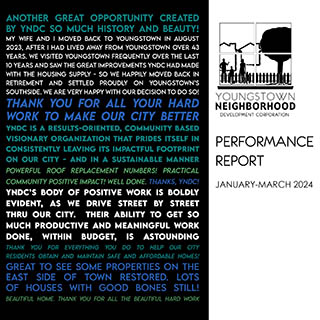
YNDC is proud to announce the publishing of its performance report from the 1st Quarter of 2024!

The performance report highlights the work of YNDC from January to March 2024.

An electronic copy can be downloaded below.