Neighborhoods


Strategic Neighborhood Transformation

Sidebar images:
Body:

There was no shortage of prominent personalities and trends featured on the front pages of The Vindicator this year.

Arno Hill, the mayor of Lordstown, was out front in his support of a HomeGoods warehouse in his village that would create hundreds of jobs and bring in much-needed revenues.

The health of Youngstown Bishop George V. Murry took center stage as he battled leukemia, and U.S. Rep. Tim Ryan of Howland, D-13th, was at the forefront of several issues, including his political battles with President Donald Trump.

Here are the top people and trends for this year as selected by Vindicator staff and editors.

1 - Certainly one of the most far-reaching stories of the year, and one of the most heartbreaking, is the story of Amer “Al” Adi Othman.

The former owner of the Downtown Circle Market and Circle Hookah lounge, Adi, a native of Jordan, became a local symbol for the crackdown on undocumented immigrants by the Trump-empowered Immigration and Customs Enforcement agency.

Adi’s story was a roller coaster, particularly for his family, who watched him face deportation, celebrate a potential reprieve and then disappear when ICE agents apprehended him during what was supposed to be a check-in meeting.

The fight to keep Adi in Youngstown included politicians from both parties and a sizable show of support from the public, but the outcry was not enough to stave off the deportation.

Adi was deported to Amman, Jordan, on Jan. 29 after a two-week hunger strike. The family sold its downtown businesses in September, and Othman’s wife, Fidaa Musleh, moved to Jordan to be with her husband.

2 - Dave Green, United Auto Workers Local 1112 president, and Mary Barra, CEO of General Motors, often found their names in the headlines. GM and its Lordstown assembly plant were often the subject of bad news this year. In June, Lordstown’s second shift was eliminated, and on Nov. 26, GM announced it would idle five North American plants, including the plant at Lordstown.

Green, newly elected to his position as president of the union local, was thrust into the spotlight as the 1,500 remaining workers at the plant – and their families, and the thousands of workers whose jobs are dependent upon the plant – looked to him for guidance in the face of the doomsday they’d dreaded for decades. To read the full story from the Vindicator, click here. 

Sidebar images:
Body:

One story we followed extensively in 2018 was the effort to stop what was being described as "predatory land contracts" in the city of Youngstown.

In the contracts, out-of-town companies would buy abandoned homes and resell them for much more than they're worth.

On Wednesday, Youngstown City Council will vote to regulate the contracts, but two groups say the law doesn't go far enough and wants council to vote no.

One house on Youngstown's E. Lucius Avenue was -- until it was torn down -- used by the Youngstown Neighborhood Development Corporation (YNDC) to show how Vision Property Management of South Carolina would lure people into what YNDC officials call predatory land contracts.

At one point, there was a sign offering the house for $12,000.

But selling a house like that one, and allowing someone to live in it, would change under the proposed new law in Youngstown.

"If someone wants to enter into a land contract they have to actually get a home inspection on that property that shows it's in compliance with city code, that it's habitable before they can put somebody into the house," said Jack Daugherty, YNDC Neighborhood Stabilization director. To read the full story from WKBN, click here.

Sidebar images:
Body:

Wednesday, January 2, 2019

On Thursday, December 27, the Schwebel Family Foundation awarded YNDC with a $1,000 grant.

Many thanks to the Schwebel Family Foundation for their support of YNDC! REVITALIZE.

Sidebar images:
Body:

Wednesday, January 2, 2018

On Thursday, December 27, 2018, the Pollock Personal Foundation awarded YNDC with a $10,000 grant for Corridor Improvement Corps.

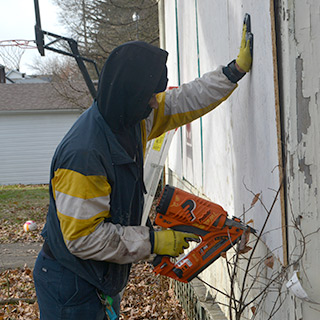
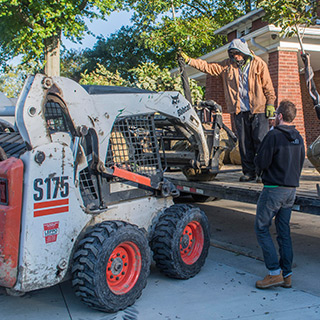
The Corridor Improvement Corps is a comprehensive revitalization strategy aimed at improving public health, safety, and quality of life for residents by leveraging AmeriCorps members and community volunteers to complete physical improvements to Youngstown’s neighborhood corridors. The improvements will include 1) cleaning up and painting blighted walls and facades of vacant buildings, 2) cleaning up and clearing overgrowth from vacant lots littered with debris, 3) planting hearty urban trees, 4) installing split rail fencing along vacant lots, 5) replacing broken and unsafe sidewalks, 6) installing covered benches at public spaces and bus stops, and 7) improving corridor lighting and signage around public spaces and corridor businesses. When applied systematically, these improvements will restore a basic sense of order to Youngstown’s corridors and will result in sustainable improvements to the safety and quality of life for Youngstown’s residents. Many thanks to the Pollock Personal Foundation for the support! REVITALIZE.

Sidebar images:
,
Body:

Wednesday, January 2, 2018

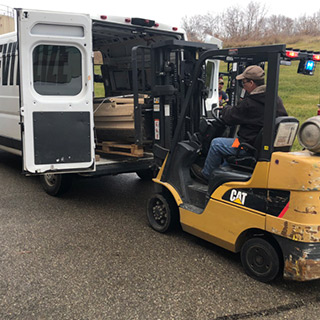
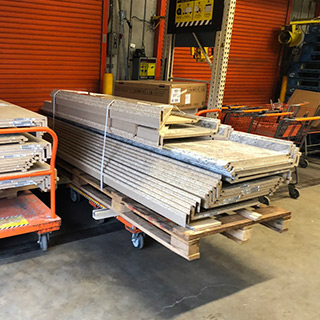
On Friday, December 28, 2018, the Home Depot Austintown store donated 82 new counter tops to YNDC for use in housing projects.

The counters will be used in YNDC's ongoing housing rehabilitation work. Many thanks to the Austintown Home Depot! REVITALIZE.

Sidebar images:
Body:

According to Councilwoman Basia Adamczak, Youngstown City Council decided Wednesday night to send the proposal to regulate predatory land contracts back to the Community Planning and Economic Development Committee.

She says council wants to look further into what YNDC and ACTION want added to it.

The current proposal would require any property sold under a "land installment contract" to have a home inspection and title search.

What YNDC and ACTION officials are demanding to be added is an appraisal and a minimum $5,000 penalty paid by the company to the victims of predatory contracts.

"It's unfortunate because people do fall victim to predatory lending so it's definitely an issue that we do have here in Youngstown that we do need to solve. But at the same time, there's those landlords that are good and diligent landlords that we need to make sure are protected as well. So that's why we need to come back together and have conversation," Adamczak said. To read the full story from WKBN, click here.

Sidebar images:
Body:

City council postponed a vote Wednesday on legislation to help stop certain predatory lending contracts because local activists who back the policy change want to include tougher language.

Specifically, Alliance for Congregational Transformation Influencing Our Neighborhoods [ACTION] and the Youngstown Neighborhood Development Corp. want the proposal to require appraisals for every land-installment contract and a minimum $5,000 fee paid by companies to victims of predatory contracts, said Councilman Julius Oliver, D-1st, who is co-sponsoring the legislation.

Council, he said, is in agreement that those two provisions will be added.

“We are on board with it and we want to protect the citizens as much as possible,” Oliver said. To read the full story from The Vindicator, click here.

Sidebar images:
Body:

Michael Rulli traces his interest in politics to childhood. Specifically, it was a trip with his Poland elementary school class to the Ohio Statehouse in Columbus that first got him curious about government.

During that tour, the students learned about the upper and lower chambers of the state legislature and how legislation gets passed. “It was very, very intriguing,” he says. Now Rulli, operations manager at Rulli Bros., will make that trip regularly and participate in that process as the new state senator who represents the 33rd district. The Leetonia Republican’s Nov. 6 victory in the district once represented by the late Harry Meshel and, more recently, Joe Schiavoni, marks the first time the seat has been held by the GOP. He defeated veteran Democratic lawmaker John Boccieri. The 33rd district is composed of Mahoning and Columbiana counties, which were combined to form the district following the 2010 U.S. Census.

For 20 years before that, the district consisted of Mahoning and Carroll counties, with a sliver of Stark County, and in the 1980s, the district was composed of Mahoning County with a portion of Stark. In the 1970s, the district was made up of Columbiana County and a portion of Mahoning County. Several people in Columbiana County approached Rulli, who served eight years on the Leetonia Board of Education, about running for the seat about to be vacated by Schiavoni, a Boardman Democrat leaving because of term limits. Schiavoni ran last election with no Republican opponent. “We didn’t want that to happen” this election, Rulli says.

Columbiana County Commissioner Mike Halleck was the first to suggest that Rulli could win. “I’ve always been able to look at people and look at the qualities that I think makes them very electable,” Halleck says. Plus, in politics name identification is “half the battle,” he notes, an advantage Rulli had because of the century-plus history of his family’s business. Rulli Bros., founded in 1917, operates grocery stores in Boardman and Austintown. Halleck also saw the changing political environment. Once-Democratic Columbiana County has shifted to solidly Republican, and the 6th congressional district, represented by Bill Johnson, is perhaps the most Republican district in Ohio, he says. And in the 2016 presidential election, Donald Trump got 46% of the vote in Mahoning County, traditionally a Democratic stronghold. “When you put all those things together, I knew it was doable,” Halleck says, and Rulli “had the personality to do this.” “Candidate recruitment is a partnership between our campaign committee and the residents of the district,” says Alex Bilchak, political director for the Ohio Republican Senate Campaign Committee, which contributed about $263,000 to Rulli’s campaign. “In Michael’s case, we heard from civic and political leaders throughout the Mahoning Valley who thought he offered an inspiring personal story and a unique business perspective,” Bilchak says. Rulli was a “job creator and a problem solver” rather than a career politician. Rulli’s experience on the school board served as an example of what that perspective can bring to government. When the Leetonia district declared a fiscal emergency, Rulli ran for the school board and helped the district regain its financial stability. “That’s the kind of positive, results-oriented leadership voters wanted,” Bilchak says. Among the main issues Rulli wants to address in the statehouse is the region’s brain drain. During a meeting Dec. 11 with business and community leaders sponsored by the Youngstown/Warren Regional Chamber, he defined his approach to keeping young people in the Mahoning Valley with one word: creativity. “You need to have creativity. You need to have a reason for young people to stay here,” he says. “Until we approach that, it’s going to keep getting worse.” The new state senator marvels at the scene in downtown Youngstown, from the growth of the Youngstown Business Incubator to the night life at its bars, restaurants and entertainment venues. People used to talk about the “old glories of Youngstown. But now downtown Youngstown is incredible,” he says. At the same time, many of the main arteries leading into downtown are in “horrific” condition and need to be addressed, he says. Now is the time, Rulli says, to capitalize on the growth of the downtown and spread that throughout the Mahoning County, starting with road resurfacing. County Engineer Patrick Ginnetti has approximately $25 million in projects scheduled over the next decade, he notes. Roadwork would   enhance the efforts in the neighborhoods by grassroots organizations such as Youngstown Neighborhood Development Corp. “Columbus isn’t going to fix every problem,” he says. But getting local officials together to assemble priorities has to begin with him.

“To get funding for [Ginnetti’s] projects would be incredible. We could get into these neighborhoods, especially the South Side, and start bringing these neighborhoods back one street at a time,” Rulli says. “There are all these different groups and projects where they’re trying to clean up these different neighborhoods. If the main arteries are brand-new and paved, that’s just the beginning. That’s just the steamroller effect of taking back the 33rd [district],” he says. Rulli also touts the $10.8 million federal transportation grant awarded to Youngstown to fund road improvements on Fifth Avenue and around downtown. To read the full story from The Business Journal, click here. 

Sidebar images:
Body:

The development of the Glenwood Business Center, clients buying 186 homes and projects across the South Side were among the highlights for the Youngstown Neighborhood Development Corp. in 2018.

Formerly a distribution center for Second Harvest Food Bank, work on the Glenwood Business Center, 2246 Glenwood Ave., was completed with the assistance of a $150,000 CommunityWINS grant from the U.S. Conference of Mayors and Wells Fargo. The first two tenants, Inspiring Minds Youngstown and Ursuline Ministries, moved into the space in October.

Elsewhere along the Glenwood Corridor, YNDC also renovated a 5,200-square-foot, four-unit apartment building on Clearmount Drive, cleared 66 parcels for use by the Mahoning County Land Bank and as greenspace, planted 20 trees and maintained 334 vacant lots. To read the full story from The Business Journal, click here. 

Sidebar images:
Body:

In getting 2019 started, we spent a ton of newsroom time this week sifting through our 2018.

The work was to offer up our best of 2018 for the Ohio Associated Press Awards. It’s the Oscars or Golden Globes of our industry.

Ohio is one of the best newspaper states in the country in terms of quantity and quality. So our work gets measured against tough competition.

Going through the work took my mind back to the many conversations I had at the end of the year with some readers. We made adjustments to the size of The Vindicator print edition, which upset some readers. It’s smaller. All U.S. newspapers are smaller today – even the New York Times.

Many phone calls ensued. One conversation represented many of the calls. She was a spry, quick-witted Struthers reader who wanted a few pounds of flesh from me.

“I’m paying more and getting less” was her gist. She chipped away for a few minutes along this theme. (It’s on our Facebook page if you want to have a fun listen. Check under “Video.”)

I asked if I could speak. When she allowed, I used her as a comparison to us. My point to her: She was older. She is less than she was in certain ways.

“But are you less valuable?” I asked very, very delicately. “You still have a lot to contribute,” I attested as I gathered my flesh she had just torn through. “So does your daily newspaper,” I finished.

With that, she changed her perspective and her cancellation plans – agreeing that both she and her newspaper still are of value amidst lessened capacities.

Sifting through our 2018 work this week validated that thought. Honestly, our work seems to move so much faster in our compressed world. Some of these events seemed years ago. Yet they were just 2018:

Little for me has been as audacious as the deportation case of Youngstown businessman Al Adi. Chip as you will at events when he entered America 40 years ago, what he’d done in Youngstown is outstanding. The lack of humanity our own government demonstrated was as sickening as I’ve seen.

I wish we had hidden camera of Gov. Kasich when – over the course of a few days – his bold education move in Youngstown seemed fried. His top commission members Brian Benyo and Jen Roller abruptly quit. Then within days, some of the cause of their concern, schools CEO Krish Mohip, showed up on four job searches across America. Alas, school still happened.

Youngstown is beleaguered by nonlocal property owners with sketchy programs for local citizens. The Youngstown Neighborhood Development Corp. and ACTION took one company – Vision Property Management – to task. A busload of “had enough” leaders and citizens trekked to Vision offices in South Carolina to seek changes. They then went one better and marched into the neighborhoods of Vision’s two corporate executives. It was one of my favorite events of 2018.

How Liberty’s Loraine Lynn died is one of those events that needed a longer look. She was murdered in 2017, said the Trumbull County coroner. And she was twice the victim due to shoddy police investigation. Local media could have been more vigilant, too, including us. The Vindicator team got a second chance to revisit the case in 2018. Watch for more from this in 2019.

TJX is coming to Lords-town, and that process was fascinating. While I no doubt wanted the jobs to come here, I was a fan, too, of the opposition. It’s the American opportunity that allows them to band together, fight back, create a voice and then manage the project to a different outcome than what was being thrown at them. There’s a how-to lesson there for future developments. To read the full story from The Vindicator, click here.